Thursday, February 28, 2013

Blessings and Joy Heaped Beyond Measure

     It has been very difficult these last few weeks to keep silent about my interviews and hearing back from PA programs. It's a great relief to finally talk about how they went and what's happening in the future. The short story is that I'm starting PA school this year!! Here's the longer story: 

Just beyond Deadman Pass
     My first interview was at Idaho State University, which has two different campuses for its PA program. My interview was supposed to take place in Pocatello, the main campus in southeastern Idaho. The day before the interview my mother and I drove to Boise, arriving safely despite the snow we encountered while crossing the Blue Mountains (which was the heaviest as we passed through the alarmingly named "Deadman Pass"). That night we heard repeated warnings about road closures and accidents due to the snow. My interview wasn't until 2 pm, but we planned to leave early the next morning so we'd have plenty of buffer time for bad weather. We never left. 
Driving back through the Elkhorn Mountains
     During breakfast I received a call saying the Pocatello campus was closed due to the weather and road conditions (the first time in years that this had happened). However, they were willing to open the campus for the interviews since most of the applicants were from out of town. When ISU learned where I was they suggested a safer alternative to driving hours through hazardous roads: I could simply go to their Meridian campus just outside of Boise and conduct my interviews via video conferencing. I'll admit that it felt a little weird to do an interview with someone via video but it worked quite well, and it really was the best choice. Everyone at ISU was very friendly and made me feel quite comfortable. 
It was a bit cold in Baker City.
     Once the interview was over my mom and I were able to begin our journey back home. That night we stopped in historic Baker City to get well rested before finishing the last 5 hours of the 8 hour drive and to celebrate my first interview. We soon had added reason to celebrate. ISU uses a system for their PA program that allows them to give almost immediate feedback on an applicant's acceptance status. Applicants are given a score based on a few pieces, the interview being the last one, and applicants with a certain score or higher are automatically offered a seat in the program. Everyone else is considered "in review" until interviews are completed, though they can ask the school at any time where they are in the rankings. Shortly after arriving at our hotel for the night, I received an email saying that my status had been updated. I went to the site to check it, fully expecting to see that I was "in review" and was absolutely floored to see this: 


There was great celebrating in Baker City that night. And tears. And excitement. And laughs of disbelief. The celebration did not end that night. I came home the next day to find this: 


My dad was very proud of his decorations. 

     A few days later I left home again, this time on an airplane to southern California for an interview at Western University of Health Sciences. While I flew down alone, I was again blessed to go to this interview with family. My dad's sister's family lives just north of LA I was lucky enough to spend almost two whole days with my aunt and uncle. I don't get to see them nearly enough so it was a real treat. My aunt was amazing and even drove me to my interview, which was quite an act of love considering check-in was at 7:30 am and Pomona is about 2 hours from my aunt and uncle's house. It was a very early morning, but we made it, and even had time to stop for breakfast along the way. 
Another testament to my aunt's love for me.
     I'll admit that I hadn't been sure how I'd felt about Western before I arrived. Talking with an alumna, as well as my own research of the program, had made me feel that perhaps Western was not a good match for me. Being there definitely improved my opinion. I still felt that perhaps I was better suited for ISU, due in part that I still have the native Oregonian's dislike of California and find the constant heat and sunshine unnatural, but the people at Western were quite nice and helpful. They even included tips on financial aid that were applicable for any PA program. The interviews were also over quickly, which meant that my aunt and I got to have a little fun at Disneyland before meeting up with my uncle for my last night there. No matter how I may feel about year-round warmth and lack of seasons, I have to say that it was nice to wear sandals and actually feel heat from the sun again. I needed that extra warmth because just three days after returning home from California I boarded another flight, this time to Massachusetts, my home for my undergrad years. 
Boston Public Gardens at night
     My trip to Massachusetts was a bit of a mini-vacation, something I certainly needed after the recent craziness of work, EMT classes, and interviews. I was able to spend a week just catching up and hanging out with friends, including my professors and bosses from college, as well as just generally relaxing, preparing for my final interview, and getting caught up on work. Finally, the day arrived. The night before my interview at Massachusetts College of Pharmacy and Health Sciences University (a ridiculously long name, I know) I'd headed into Boston to stay with a friend there so I wouldn't have far to go in the morning. My friend lived conveniently close to a T stop so all I had to do was hop on and ride to the Longwood Medical Area. 
     I'd had a feeling before I even made it to the interview that MCPHS was my top choice school. For anyone who read the post about my "belated birthday present," MCPHS is the school to which I was referring. Still, there was always the possibility that I would get there and something would radically change my mind. One question I was very curious about was how MCPHS did their anatomy labs. One of the alumna from Western University had informed me that the PA students there had a lab to go along with their anatomy class, but they didn't actually do the dissections; the medical students did and they just watched. I then asked an alumna from ISU about their anatomy classes and found out they don't even have labs, basing this policy on the fact that a PA cannot simply open up their patients to look inside them and figure out what's wrong. I sort of understand that, but at the same time, surgery is a required clinical rotation, and I just think it is very important to have an excellent understanding of the internal anatomy of a human person if you are going to correctly diagnose and treat them. Before I could even ask someone about the labs at MCPHS, a faculty member answered my question: they didn't have enough room on their facilities for an anatomy lab, so instead they purchase cadavers for the PA students and then have them walk across the street to use the anatomy lab at Harvard School of Medicine... which is just awesome. It's pretty much one of the best setups I could imagine.  

The Longwood Medical Area with MCPHS highlighted
      As I mentioned earlier, MCPHS is in the Longwood Medical Area, pictured above. For those of you who don't know, this area is one of the most highly concentrated areas of medical learning, research and practice in the country. I already mentioned that the Harvard Medical School is across the street, but just a block or so in other directions there are Simmons College and Emmanuel College, to name a few of the other colleges in the area. Northeastern University is a bit further down and MIT is just across the Charles River. When it comes to hospitals and medical research centers, the Longwood Medical Area is also home to some of the best. Brigham and Women's Hospital is just two blocks away, Dana-Farber is next to that, and the Joslin Diabetes Center is next to that. If you want to know all the universities, hospitals and research centers in the area, just look at the Wikipedia page. What I'm saying, in short, is that MCPHS has one of the best locations of any of the PA programs in the country, and it's really rather exciting. This is just another reason why I wanted to attend MCPHS, and why I really wanted to make a good impression at my interviews. 
     This post has already become rather long, so I'm going to try to wrap it up quickly. Here's the dealio: the interview day (applicants were given an overview of the program, a lecture, a timed written essay, lunch, time with members of the student association, and a tour before the actual interviews) went really well. I felt super comfortable and I left the campus thinking that I truly wanted to be accepted to this program. I flew home though thinking that I would have to wait a whole month before I heard anything. It was an amazing surprise when I arrived home early from work two Saturdays ago and saw the lovely letter to the right waiting for me. I could barely make it into the house because I was basically bawling my eyes out with tears of joy. It still seems hard to believe. I feel so incredibly blessed. Not only am I going to be starting PA school this fall, something I'd been sure would probably not be for another year, but I get to go to my first choice school. I look forward to where God will lead these next three years. It's quite an adventure I'm starting and I want to thank all the friends and family who have supported me the whole way. THANK YOU SO MUCH!!

Coming Soon: There seems to be a lot of confusion about what a PA is and what they do, so I'll be clearing that up in my next post. :)

Saturday, February 2, 2013

The Waiting Game

Mt. St. Helens, Mt. Rainier, and Mt. Adams from the flight home.
     Now comes one of my least favorite parts of applying to PA schools: the waiting. The crazy month of interviews is over and now things are out of my hands. There is nothing left for me to do but wait. Well, wait and work that is. My boss was nice enough to let me take off half the month of January in order to travel to my interviews so now I'm definitely going to be making up for all that time off by working much more than usual. I'm certainly not complaining though. From everything I've heard, PA schools are very intense and most schools actually forbid their students from working while they're in the program, so I have no problem with working a lot now so I can completely focus on school later. Now the big question is: which school will it be? The schools at which I interviewed all have different time schedules for when they make their final decisions, so I will be hearing from them at various times. The latest I should hear back would be late March, but most of the schools said they'd get back to me by the end of this month. Until then, I'm going to enjoy my time at home and try to be patient.

Sunday, January 27, 2013

Brrr... It's Cold Outside

This was my life just 1 1/2 weeks ago.
My life this week.


     The time has finally arrived for my final interview. These last few weeks have been fun, but I have to admit that it will be nice to be at home for more than three days at a time again. It'll also be nice to have to deal with just one temperature range again. I've gone from 12F in Idaho to 75F in California, and now I'm facing 22F plus windchill in Massachusetts. I'd forgotten just how quickly wind can turn your face into ice. At least all the places I've visited have been quite sunny. I don't often get to see the sun in the winter in Oregon, so it's nice to see a bit more of it, even if it's a bit too cold to stay outside long. 


     Despite all the crazy weather and the stress of interviewing, I've been pretty good about making these trips for interviews into mini-vacations. After my interview in Idaho I was able to stay in an old, historic hotel with my mom, and when I went down to California I not only got to stay with my wonderful aunt and uncle, but I also got to go to Disneyland. Considering how nerve-wracking interviews can be, I think an afternoon of fun was the perfect way to de-stress. My last interview is in Massachusetts, and there is no Disneyland there. However, I might have something even better. I did my undergraduate studies in Massachusetts, so many of my friends are still in New England, and coming back here for an interview means it's reunion time. I've been here since last Wednesday night and it's been just wonderful. Sure there's no roller coasters or people dressed as cartoon characters, but I think ice-skating, cannolis, trips to the beach (wind and all), chats over coffee, and good times just hanging out with good people may trump the happiest place on earth. No matter how my interview on Thursday goes, this trip was definitely worth it. 

All bundled up and ready for ice-skating.

Tuesday, January 15, 2013

Hello Sunshine!

     Tomorrow I leave for my second interview. This one is down in California, and it looks like the recent "cold snap" (the people in LA just kill me with their inability to cope with temperatures below 50F https://www.youtube.com/watch?v=_6t-EjrtD3U) has come to an end. I think I'm actually going to have to bring shorts for after my interview. Such craziness. Of course, when you consider the perpetual fog and rain that are so characteristic of winters in western Oregon, I think a bit of sun and warmth will be quite nice. 
 
 So I'll be going from this:


To this:


Saturday, January 12, 2013

I'm So Legit


     Today I arrived home from my first PA school interview to find this lovely letter and patch (as well as a very nice certificate) waiting for me. It was an excellent surprise, especially after some long days of driving. If I so desire, I can now apply for a job as an EMT in Oregon. At the very least I actually feel legitimate now. My fellow baristas at the coffee shop where I work have also greatly enjoyed this news. They claim that they feel much safer now, though I'm not sure there's a great amount of danger in a coffee shop, aside from hot water burns and slipping on wet floors. The last, and only, time I was asked to consult on a medical issue at work was when someone got glass in their eye while changing a light bulb. Hardly a medical emergency, but still, I think it's fun. :)

Tuesday, January 8, 2013

Interview Time has Arrived!


     This week I have my first interview for a Physician Assistant program. I'm at once excited to have finally arrived at this stage, as well as worried about what will happen once the interviews begin. Last week I was fortunate enough to have a mock interview with a friend who was once a member of the admissions board at a nearby PA program. Even though I knew it wasn't "for real," I was still rather nervous, especially since my friend made it as realistic as possible, complete with a timed essay and panel interview. Like the EMT practical exam, my "panel" used their poker faces, and I've realized that the lack of feedback is probably the most nerve-wracking part for me. I felt like I was trying to be honest and present myself as best I could, but I really wasn't sure how it was going. Apparently I did alright. Despite my nerves, I'm very glad I did the practice interview. At the very least I can approach these upcoming interviews with a better expectation of what questions will be asked, and I've already thought through many of them and have answered them within a similar context to what I'll soon be facing. While I'm still nervous about what Friday may hold, I certainly feel a bit better prepared. So, Thursday it's off to Idaho and my first interview. Wish me luck! :)

Thursday, December 27, 2012

BSI. Scene Safe!

     Almost two Saturdays ago I took the Oregon EMT practical exam. My fellow candidates and I had to prove our ability to perform six skills in a competent manner. These skills were medical and trauma assessments (if you want to know what this looks like, here's an example of a Trauma Assessment), providing spinal immobilization for a supine patient (getting a patient onto a long spine board), providing CPR and using an AED (see my PSA below), ventilating a patient with a Bag-Valve Mask and inserting a supraglottic airway, and then a random skill that was either caring for a bleeding wound and shock (what everyone wanted to get because it takes 30 seconds to do) or splinting a long bone (the skill I ended up doing -an easy skill that's made difficult by the 5 minute time limit). Everyone had done the skills so often in class that we all knew how to do them, and do them well. However, nerves are tricky things, and there's a lot of waiting that goes on at the state exam so you have plenty of time to agonize over mistakes you think you've made or all the ways you could mess up the next skill. Plus, the proctors aren't allowed to give you any indication of how you've done, so you often leave a station convinced you'd done something wrong, and since you can't talk to anyone about the exam, you sit there and go over everything over and over in your head. Then you just try to figure out if it was a critical fail or not. Luckily for everyone in our class, we eventually realized that our instructor had held us to a much higher standard than the state exam and I think almost all of us passed. We went to a place down the street to celebrate, talk about how we'd done, and cheer each new victorious compatriot as they joined us. It was a great way to end the class.
Guess I'm going to need to get one of these. ; )
     The final step to becoming an EMT was to take the national exam, which I did last week. That exam is cognitive rather than psychomotor and thus tests you on your knowledge, and not on your ability to perform skills. Like the state exam though, this one also plays with your head. It's an adaptive test, so if you get a question right the next question will be harder, but easier if you get the question wrong. The computer keeps asking you questions on a particular topic until it's clear whether you should pass or not, and then it moves on to the next section. You can be doing really well, but still fail half the questions because you keep getting harder and harder questions, which is a bit unnerving. Also, the test doesn't tell you when it's switching to a new section, so you might get some easy questions all of a sudden and think you must be doing poorly, when really you're just starting a new section. Oy. Anywho, I got out in about an hour, but then had to wait four days to find out how I'd done when I received the official results in the mail because they forgot to email me my results the next day like they were supposed to. It doesn't matter though because I passed and come Jan. 1 I'll be a licensed EMT!!
How hypothermic was he when he was unfrozen? Question for the ages.
     Now that the class and whole process is over, I've certainly enjoyed having more time to focus on work and prepping for PA school interviews, but I'll admit that there are things I miss. I miss debates about whether or not Han Solo was profoundly or only mildly hypothermic when he was thawed from the block of carbonite (I hold to "mildly" since I don't think he was mentally altered). I miss hearing about real calls and how responding to a patient with ruptured esophageal varices is pretty much just sloshing through blood to check a pulse and confirm death (I would gladly explain what happens, but I don't think everyone would enjoy the details as much as I do, so look it up if you're interested). I miss quizzes where questions such as "what should you do with bystanders at the scene of a motor vehicle accident" have possible answers like "lay them in the road to act as human traffic cones" or "douse them with gasoline and tell them to light flares." I miss the bad jokes the other students would tell when we were loopy from sitting around for hours waiting to perform skills for our practical exam. All said though, I'm glad to move on to the next step and start using my new skills. First though, I have a couple Public Service Announcements.


You really should.
PSA 1: If you find yourself a bystander at the scene of an accident, here are three things you should not do: a) run up to the ambulance (running people are considered panicked/unstable and no one will exit the vehicle until you calm down), b) frantically wave us to where you think we should park/get angry if we don't park there (it's usually fairly obvious where the accident is and there are regulations about the best places to park to avoid hazards), and c) assume the EMT is an idiot. The last one may need some explaining. Often EMTs and paramedicswill do things that may seem stupid to bystanders, but only because the bystanders don't know the reasons behind the actions. For instance, my instructor was once at a motor vehicle accident where the driver was severely injured. When he first came up to the patient he asked them if they knew their name, where they were, what had happened, and if they hurt anywhere. One bystander became infuriated at this because it was obvious that the patient's leg, and pretty much everything else, was very broken and needed immediate care. What the bystander didn't understand was that the paramedic was collecting important clues that would determine care. From these questions he could determine if the patient was alert (altered mental status would increase the patient's priority), oriented (and to what degree), and whether there was any cause to suspect severe spinal cord injury (if the patient didn't feel pain, this would clearly be a problem). So, as in any area of life, don't assume that you know or understand all the reasons behind someone else's actions
This is all you need to do. Smiling not required.

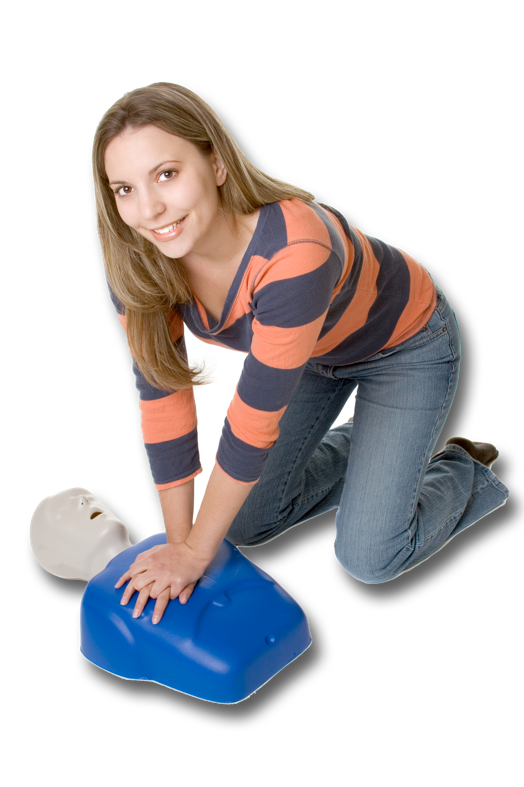
PSA 2: CPR. It's important. Sadly, few people learn how to do it, and even fewer perform it when it's needed. I have two things to say about it. First of all: just do it! CPR cannot, by itself, restart someone's heart and save their life (that's why you need a defibrillator aka an AED), but it causes the blood and oxygen to circulate so that the other cells of the body are still alive when you restart the heart. CPR classes take just a few hours, and the skills you learn are vital. You can find a course here: AHA CPR Classes. Even if you have never taken a class, you can still perform CPR. Lay people are now taught "compressions only CPR" which just means that all you do is the compressions -the pounding on the chest, rib-breaking part. There's no need to count or give breaths. It's simple. Scary, but simple. Basically, the compressions are the most important part of CPR, so please just do them until EMS can arrive. This podcast includes a discussion of the effectiveness of CPR: PodMed. In class we watched a real video of a guy who had a heart attack in his office and it took FIVE MINUTES before anyone began CPR, even though his wife arrived just as his attack was beginning. This should not be. My second tidbit about CPR is a slight modification to the first: definitely do CPR, but make sure the patient actually needs CPR first. This means you shake them and shout in their face, then if they don't respond you check for breathing and a pulse. If they have no pulse start CPR immediately. If they aren't breathing but have a pulse, you need to breathe for them. If they are both breathing and have a pulse chill out. They probably just fainted. Call 9-1-1 but don't go breaking their ribs. Our instructor told us about an old man who fainted while waiting in line at the bank and then woke up when "Rescue Ricky" immediately began CPR and broke his ribs. "Ricky" thought he'd saved the guy's life when really he just caused him agonizing pain. Or there was the group of "rescuers" who told the paramedic that a surfer had collapsed when walking back from the beach on a hot day, but was resisting their efforts to perform CPR. The poor surfer was merely overheated, and these people were trying to hold his arms down so he would stop fighting them as they tried do CPR. Please do CPR when needed, but don't let these latter stories be you.
P.S. -The title of this post comes from all the skills we perform as EMTs. The first two things you have to do when performing any skill is state that you have taken appropriate precautions by using body substance isolation (gloves, glasses, anything that prevents contact with bodily fluids) and that you have determined the scene is safe. We said "BSI, scene safe" so often that it almost became a single word we spat out without even thinking. That's good, because if you forgot to say either of the two phrases, you automatically failed the skill, even if you did everything else correctly. 


We all started doing jazz hands whenever we said BSI to represent the imaginary gloves we had one. Then we started doing it without realizing it. Our instructor enjoyed mocking us for it.